AI · HR tech · Web app
Heri.AI
An AI hiring assistant that tells recruiters what needs their attention today, and shows them why.
- Year
- 2026
- Role
- Product designer (research, UX, UI, prototyping)
- Tools
- Figma, Claude
- Type
- Concept project
Project overview
Recruiters juggle dozens of candidates across several roles, and the signal they need is buried in spreadsheets, ATS screens and interview notes. Heri.AI is a concept dashboard with an AI recruiter built in: it summarises the day, flags who needs attention, and answers plain-language questions by highlighting the exact candidates, roles and interviews it is talking about. I designed it end to end, from problem framing to an interactive prototype.
The challenge and research
Talent leads start every morning reconstructing the state of hiring from five different tools before they can make a single decision
I spoke with [x] recruiters and talent leads and reviewed how teams use ATS dashboards and AI assistants today. Dashboards show volume (applied, screened, interviewed) but not what to do next, and AI chat tools answer questions without connecting the answer back to the pipeline, so recruiters don’t trust them enough to act.
Persona
Ima, Talent Lead
- hiring for 5 roles with a small panel of interviewers
- needs to know who to act on today, which roles are slipping and why, without digging through every profile.
Key insight
Recruiters don’t want an AI that talks; they want one that points.
Every answer has to show where it came from on the dashboard.
The problem
How might we help recruiters see what needs their attention today, and trust the AI enough to act on it?
Hiring data is plentiful but scattered. Recruiters lose time finding strong candidates, notice slow roles and silent candidates too late, and can’t see why an AI tool recommends what it does.
Too much to scan
246 applicants across roles, and no clear “start here”.
Problems surface late
slow stages and unresponsive candidates are found after the damage is done.
Black-box AI
suggestions without evidence don’t get acted on.
The solution and strategy
A dashboard that leads with today’s priorities, and an AI recruiter whose answers light up the evidence
Heri opens with an AI summary and four signals (Strong matches, At risk, Interviews pending, Behind schedule), then the hiring pipeline and priority candidates. The AI Recruiter panel answers questions in plain language and highlights the matching cards, stages and people, so the recruiter can verify and act in one place. Every insight ends with one clear action: review, nudge, schedule or report.
Lead with what matters today
a short AI summary and four signals before any table.
Show the evidence
answers highlight the exact candidates, stages and interviews they refer to.
One next step
each insight comes with a single action, not a list of options.
Best explored on a larger screen.
Inside Heri
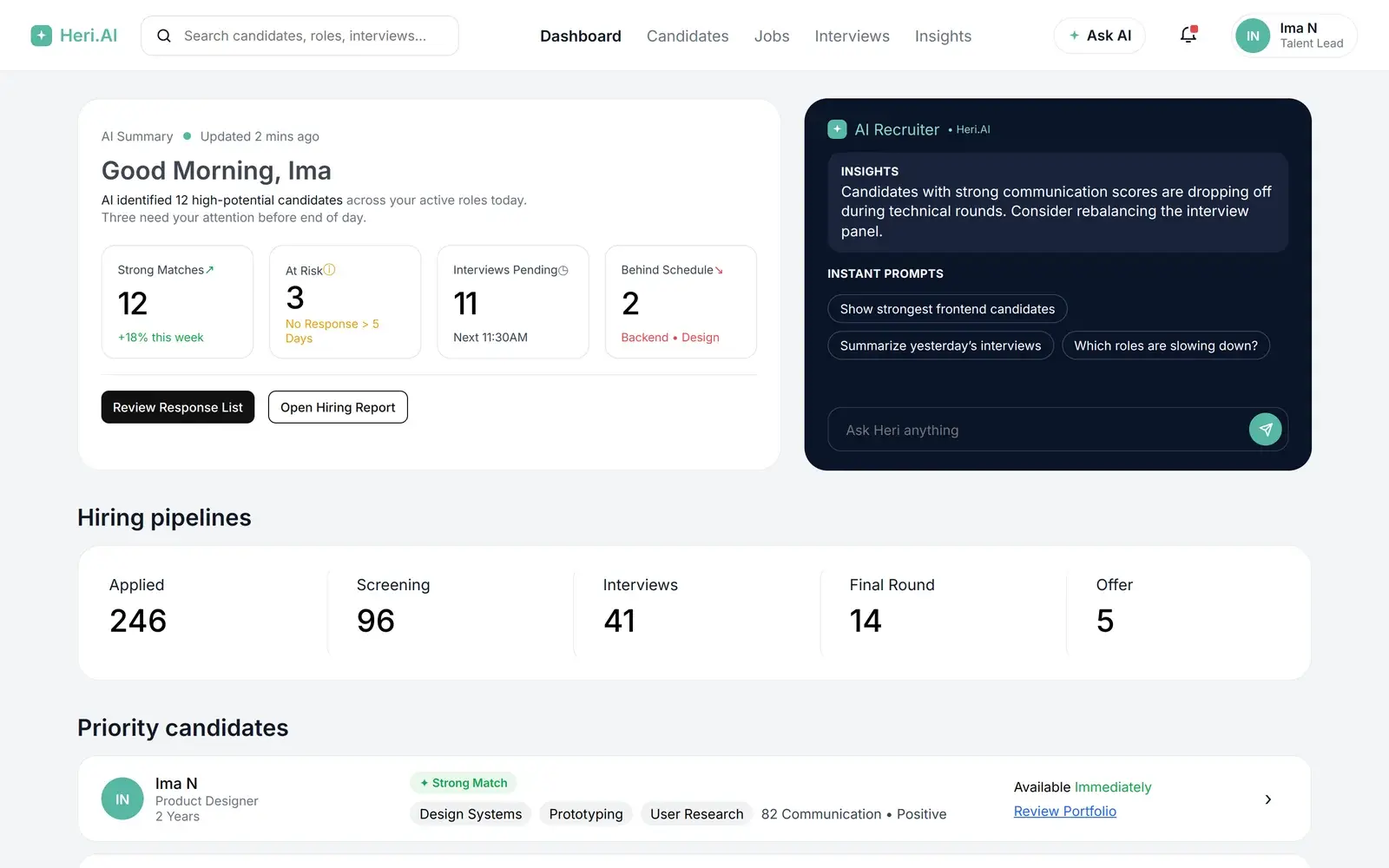
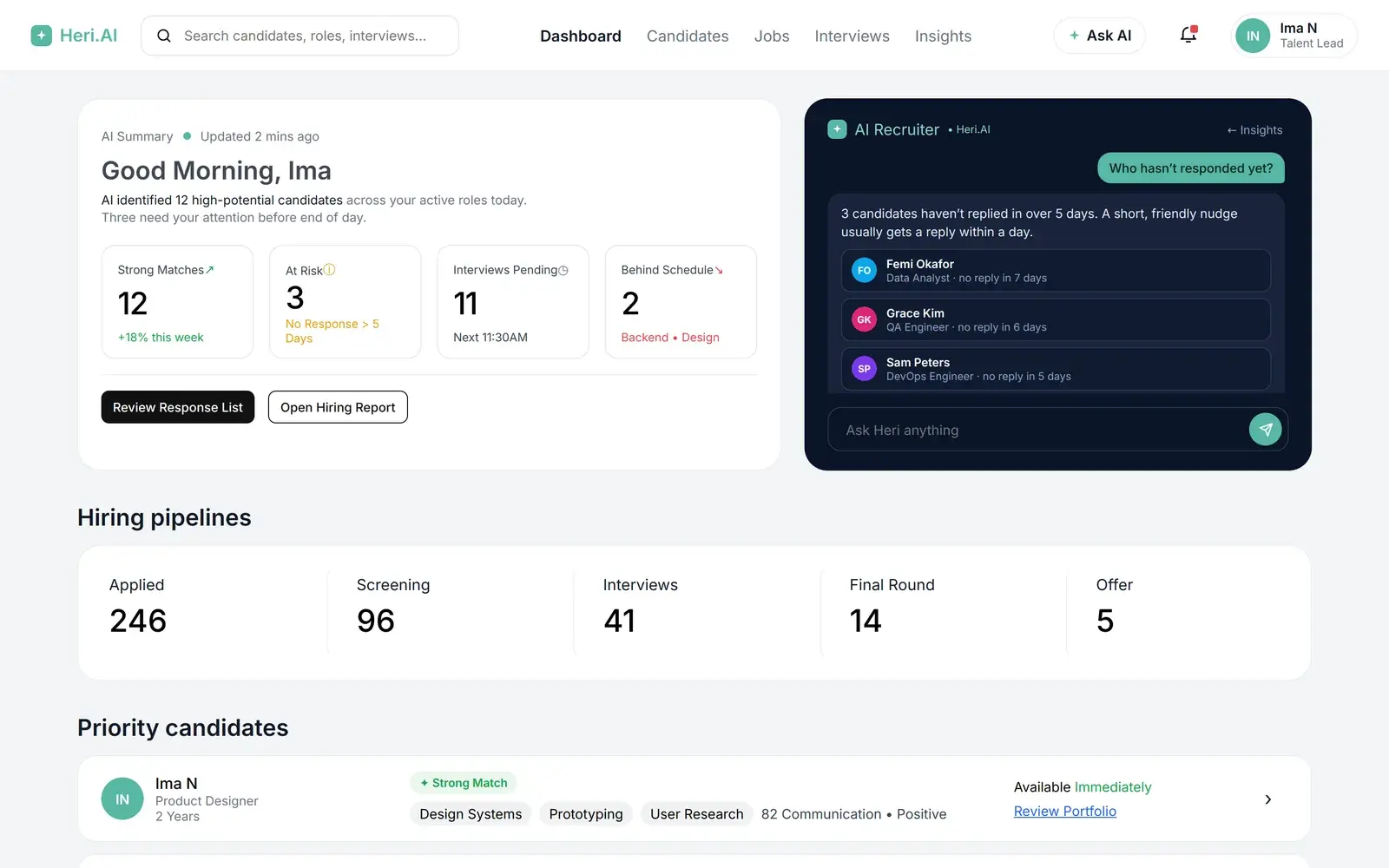
Today at a glance
The first screen answers “what needs me today?” before showing any table.
- AI summary first: 12 high-potential candidates, 3 needing attention before end of day.
- Four signals: strong matches, at risk, interviews pending, behind schedule.
- Pipeline below: Applied 246 → Screening 96 → Interviews 41 → Final round 14 → Offer 5.
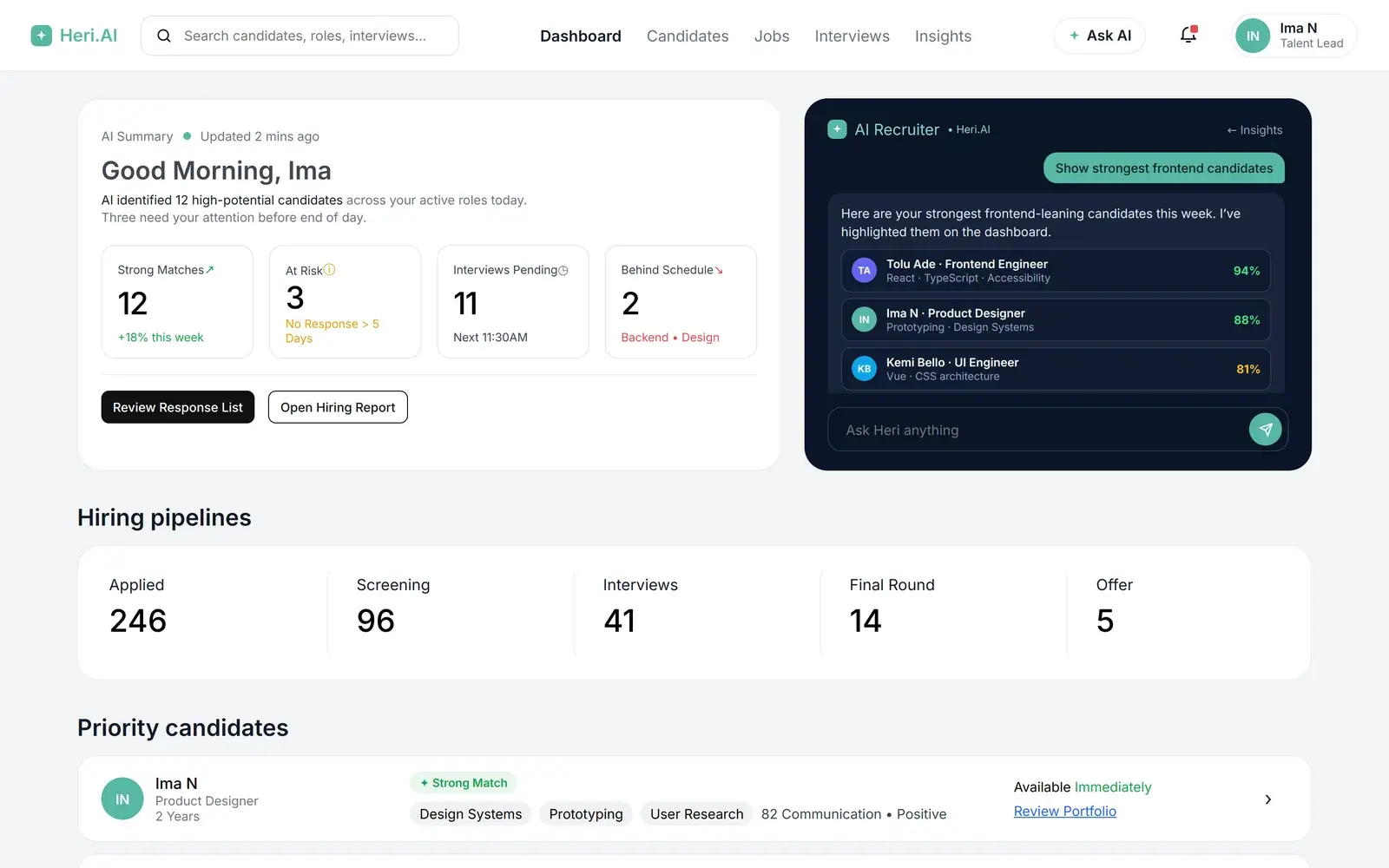
Ask Heri, see the evidence
Asking for the strongest frontend candidates returns a ranked list and highlights them on the dashboard.
- Ranked by fit: match scores (94%, 88%, 81%) with the skills behind them.
- Answers point: matching candidates light up in Priority candidates.
- Plain language: no query syntax, just ask.
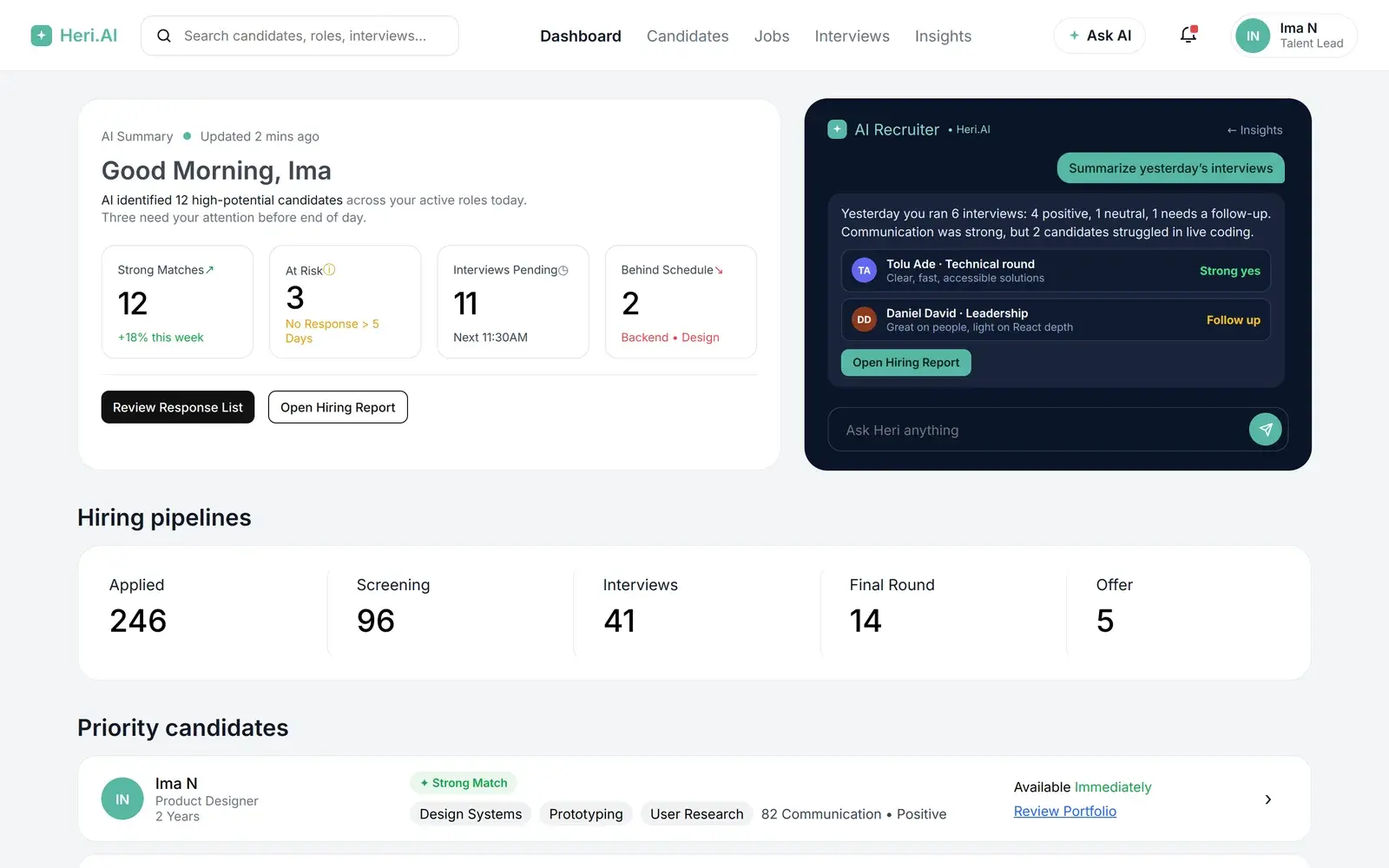
What happened yesterday
A one-line recap of yesterday’s interviews, with the ones that need follow-up.
- Outcome counts: 4 positive, 1 neutral, 1 needs a follow-up.
- Patterns, not just numbers: strong communication, 2 struggled in live coding.
- Straight to the follow-up that needs action.
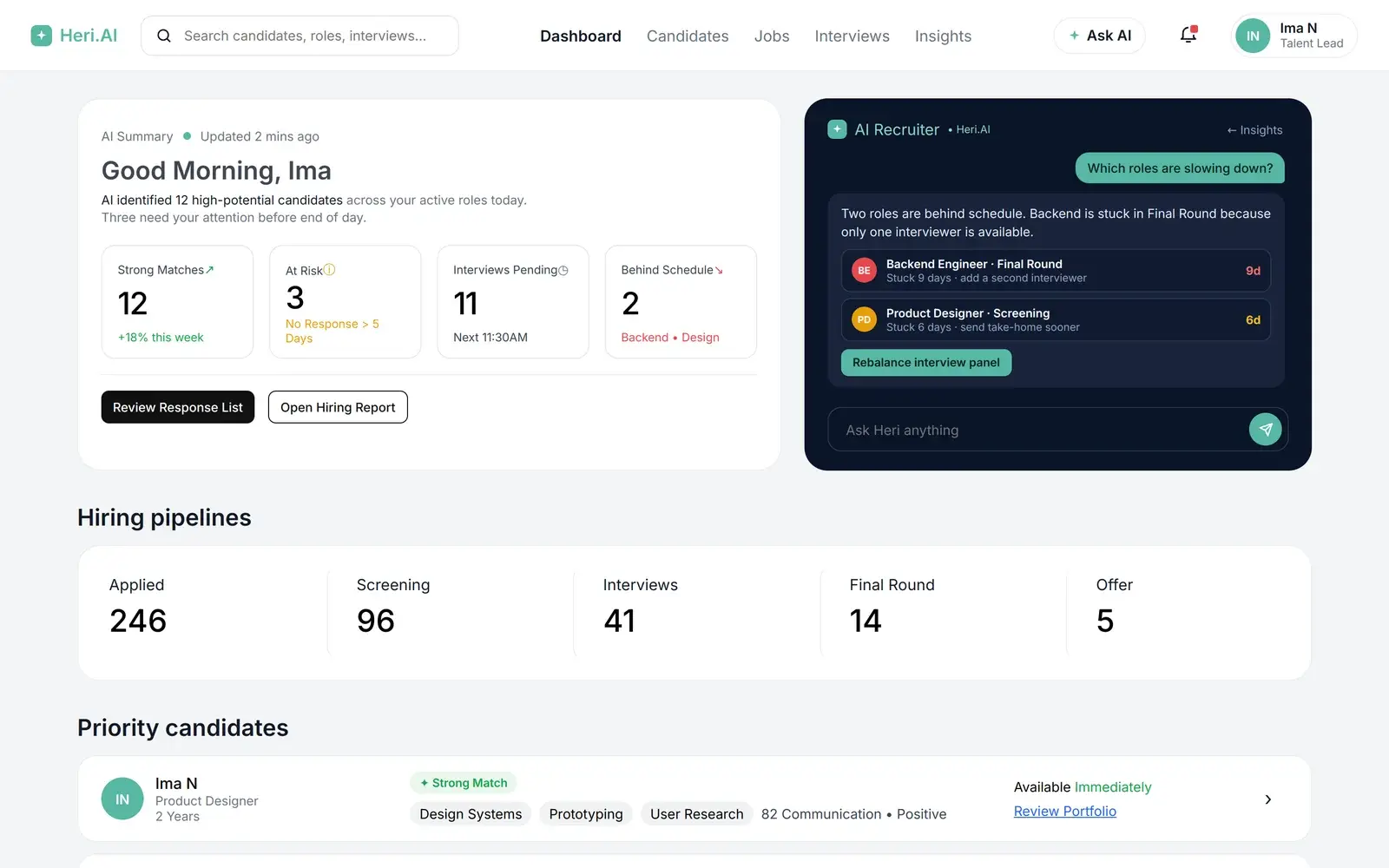
Spot slow roles early
Heri compares each stage to the team’s usual pace and explains the bottleneck.
- Two roles behind schedule, highlighted on the pipeline.
- The cause, not just the symptom: Backend is stuck in Final round with one available interviewer.
- A fix: Heri drafts a new interview panel.
Candidates going quiet
Heri surfaces candidates who haven’t replied in over 5 days, before they drop out.
- At-risk list with last contact.
- One-tap nudges.
- Fewer silent drop-offs.
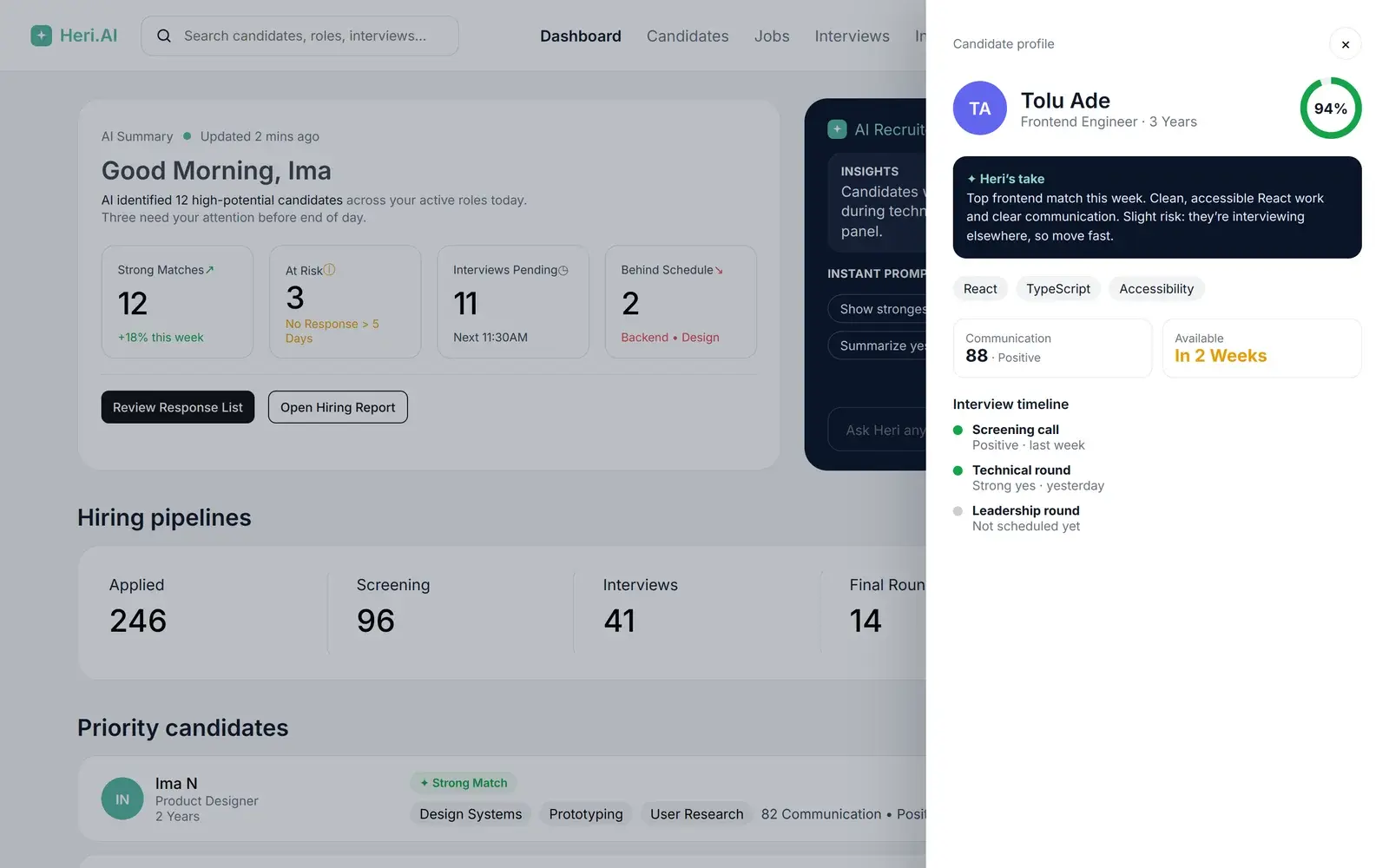
Candidate profile with Heri’s take
Every profile opens with a short AI take, then the evidence: skills, sentiment and availability.
- Heri’s take: a two-line summary of strengths and risks.
- Interview sentiment per round (Positive / Neutral).
- Availability and match score at a glance.
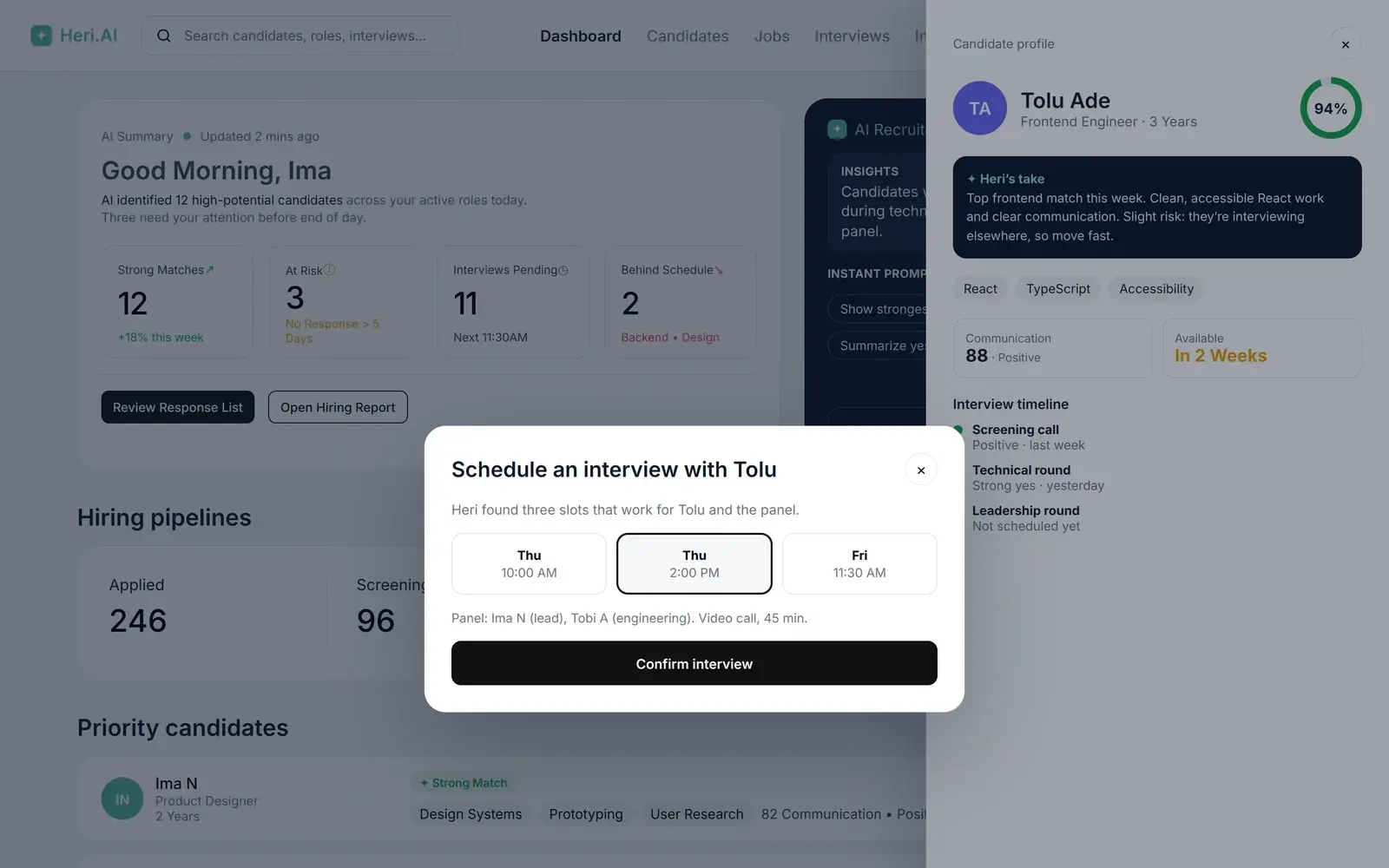
Scheduling without the back-and-forth
Heri finds three slots that work for the candidate and the panel.
- Three options, not a calendar maze.
- Panel availability already checked.
- Heri prepares a brief before each interview.
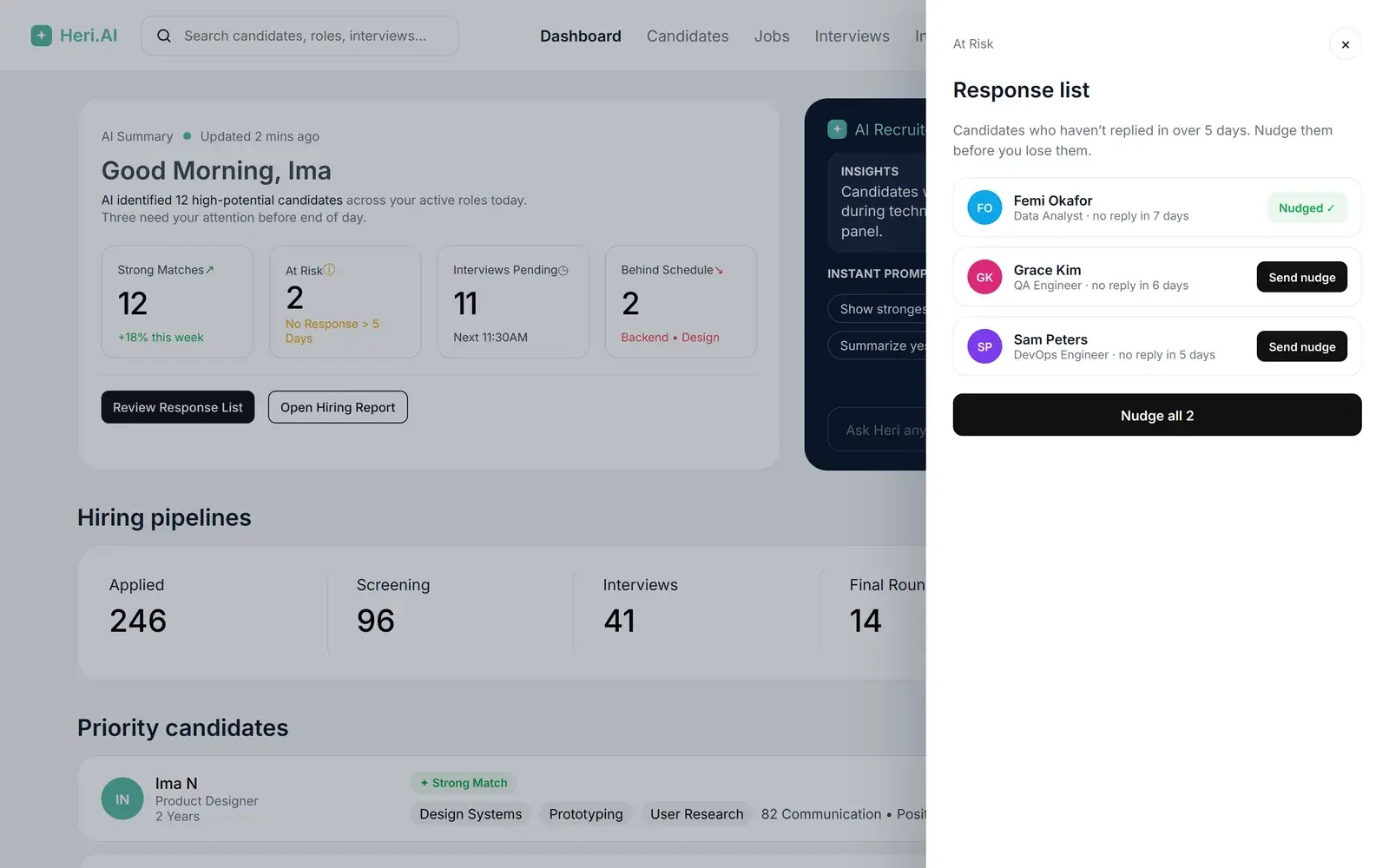
Response list and nudges
Everyone waiting on a reply, in one list, with a nudge for each.
- Who is waiting and for how long.
- Nudge one or all.
- Toast confirms what was sent.
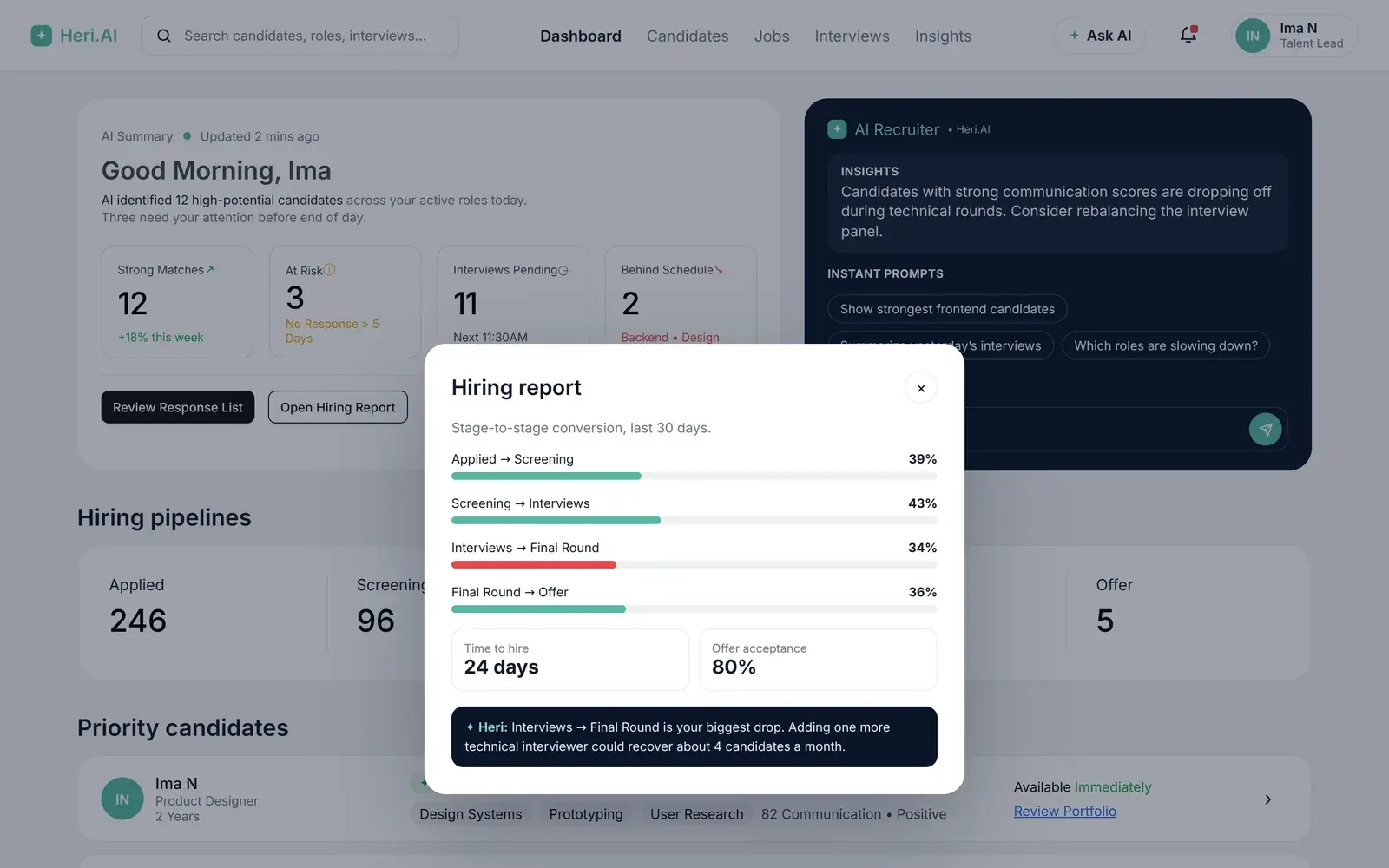
Hiring report
A shareable summary of conversion and time-to-hire across stages.
- Stage-to-stage conversion bars.
- Time to hire and offer acceptance.
- Heri’s note on the biggest drop-off.
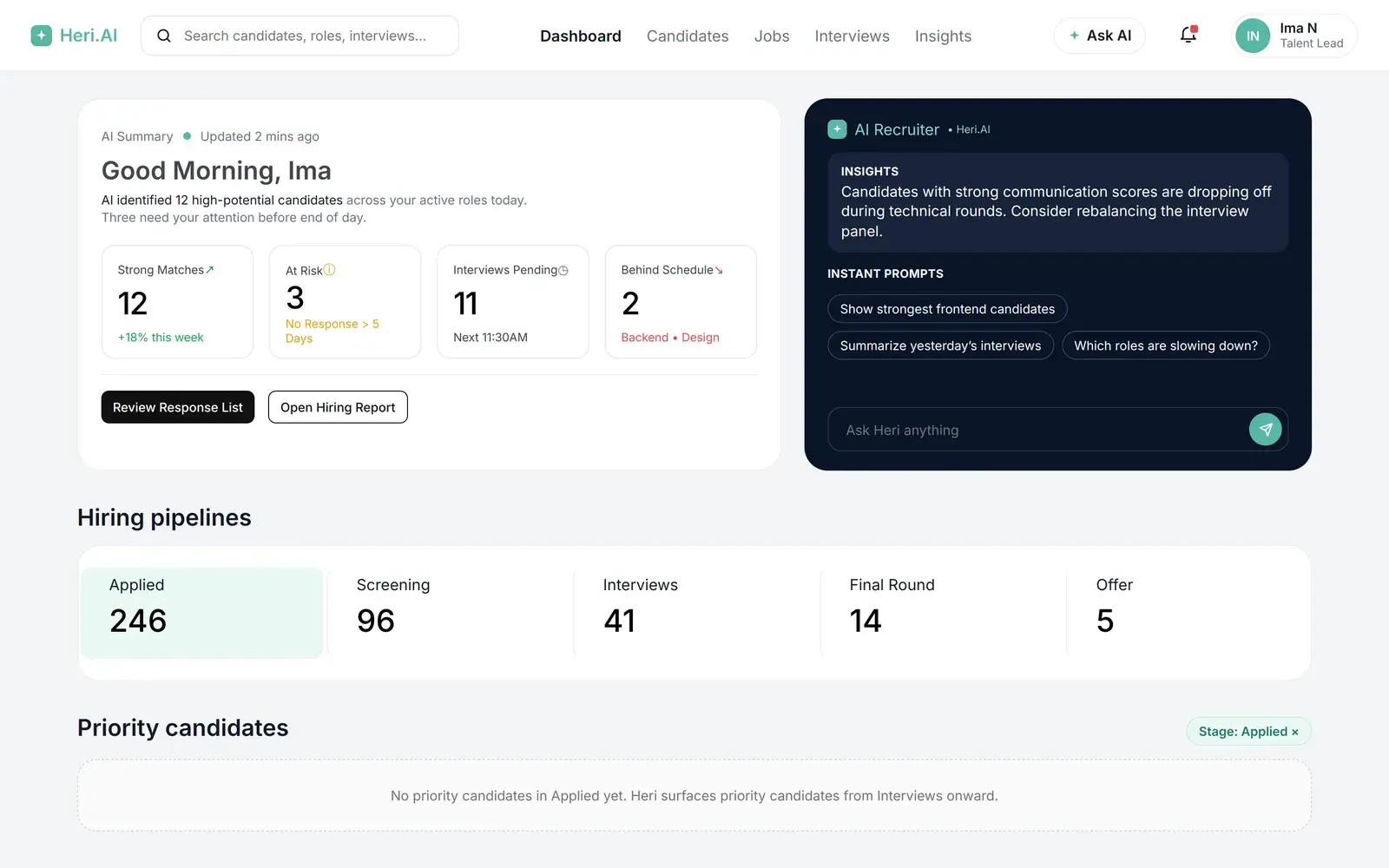
Empty states that help
When a filter returns nothing, Heri says why and how to widen it.
- No dead ends.
- Clear reset.
- Same voice as the rest of the product.
Outcome and reflection
What I’d measure
- time to first action each morning
- % of AI answers acted on
- drop-off of unresponsive candidates
- time to hire
Results
[add usability test results, e.g. task success x/5]
Reflection
Designing an AI feature is mostly designing trust: the answers became useful the moment they started pointing at the evidence. Next: candidate-side messaging and team permissions.